Author: admin

  • How to Check Which Program Is Using Your CPU

    If your PC suddenly sounds like it’s about to take off, or everything feels sluggish for no obvious reason, it’s natural to wonder what’s eating the processor. Most of the time, there is a reason. It’s rarely mysterious, and it’s rarely permanent.

    Checking which program is using your CPU isn’t complicated. Interpreting what you see is the part that causes confusion.

    Let’s go through it properly.


    What’s normal, and what isn’t

    Modern versions of Windows are designed to use available resources. If something needs the processor, it gets it. If nothing needs it, the system sits mostly idle.

    It is normal to see:

    • Brief spikes in CPU usage when opening programs
    • Higher usage during updates
    • Activity when the PC is sitting idle but connected to the internet
    • Short bursts of background activity after startup

    It is not normal to see:

    • CPU usage pinned near 100% for long periods with no obvious reason
    • The system constantly slow even when nothing demanding is open
    • Fans running loudly for hours

    Short spikes are fine. Constant saturation is not.


    Why it often looks worse than it is

    People usually open Task Manager during a moment of stress — when the system is already slow. What they see is a number in bold, often higher than expected. That number feels alarming.

    What’s easy to miss is context.

    If your CPU jumps to 70% for ten seconds while Windows completes background activity, that’s normal behaviour. If it stays at 70% for an hour while you’re doing nothing, that’s different.

    The processor is built to be used. High CPU usage by itself is not damage. It’s only a problem if it doesn’t settle.


    How to check which program is using your CPU

    Press Ctrl + Shift + Esc. That opens Task Manager directly.

    If you see a simplified view, click More details.

    Now look at the Processes tab.

    There’s a column labelled CPU. Click the word “CPU” at the top of the column. This sorts programs from highest usage to lowest.

    The program at the top is using the most processor time at that moment.

    That’s the basic answer.

    But there are a few things to understand before jumping to conclusions.


    Why Task Manager can mislead you

    Task Manager shows a snapshot of what’s happening right now. It does not show:

    • What was happening five minutes ago
    • What will happen next
    • Whether a task is temporary

    It also shows grouped services. For example, you might see:

    Those are not random names. They are Windows components performing background work.

    If you sort by CPU usage and see something unfamiliar at the top, that doesn’t automatically mean it’s harmful. It may simply be a built-in process doing maintenance.

    Another thing that causes confusion is percentage scaling. A program using 25% CPU on a four-core system might only be using one core fully. That’s not the same as the whole processor being overwhelmed.


    Looking a little deeper (without overcomplicating it)

    If the top entry is unclear, right-click it and choose Search online. That usually clarifies what it is.

    You can also switch to the Details tab. This shows the exact executable name — the actual file running. It’s more technical, but sometimes clearer.

    If you want to see longer-term behaviour, click the Performance tab and select CPU. The graph shows overall usage over time. If it spikes and falls, that’s healthy. If it’s flat and high, that’s worth investigating.


    Common causes of high CPU usage

    In most cases, the culprit is predictable.

    Windows Update

    Updates often run quietly in the background. They can temporarily increase CPU usage while downloading, unpacking, or preparing files.

    This often happens while the PC is idle or shortly after startup.

    Windows Defender

    Security scans use processor time. If Defender is scanning, you’ll see activity. It usually settles once the scan completes.

    Search Indexing

    If you’ve installed new programs or added many files, Windows may reindex content. That can cause noticeable background activity.

    A web browser

    Modern browsers can use significant CPU if:

    • Many tabs are open
    • Video is playing
    • A page is poorly optimised

    It’s common for a browser to appear at the top of the list.

    Third-party software

    Occasionally, an application misbehaves and fails to release CPU resources properly. This is less common but does happen.

    Usually, closing and reopening the program resolves it.


    When it resolves on its own

    In many cases, high CPU usage is temporary.

    Typical timeframes:

    • Windows Update: 5–30 minutes
    • Defender scan: depends on disk size, often under 30 minutes
    • Indexing: can take longer after major updates, but gradually reduces
    • Startup background tasks: usually settle within 10–15 minutes

    If you leave the PC alone and CPU usage falls back down, the system was just catching up.

    That’s normal maintenance behaviour.


    When it’s worth investigating further

    You should look closer if:

    • CPU usage remains high for hours
    • The same program constantly returns to the top
    • The system feels permanently slower
    • You see unknown software using significant resources

    In that case, the goal isn’t to panic. It’s to identify whether:

    • A specific application needs updating
    • A driver is misbehaving
    • A scheduled task is repeatedly failing

    Persistent issues are usually software conflicts or update problems — not hardware failure.


    What not to do

    This is where people often make things worse.

    Don’t immediately end random processes

    If you start ending system processes at random, Windows may restart them. Or worse, you may interrupt something important.

    Ending a web browser is fine. Ending core Windows services without understanding them isn’t.

    Don’t install “PC cleaner” tools

    Many third-party optimisation tools promise to reduce CPU usage. Most add their own background services and create more load.

    If you can’t identify the program in Task Manager yourself, adding more software isn’t the solution.

    Don’t assume high CPU means hardware damage

    Processors are designed to operate at full load. They throttle themselves if necessary. High usage alone does not harm them.

    The concern is sustained, unexplained behaviour — not brief peaks.


    A simple way to think about it

    Your CPU is a shared workspace. Programs take turns using it. Sometimes one program needs more time. That doesn’t mean it’s broken.

    When you check Task Manager:

    1. Sort by CPU
    2. Identify the top process
    3. Ask: is this something I recognise?
    4. Wait a few minutes and see if it drops

    Often, that’s all that’s needed.


    The grounded reality

    If your PC feels slow and you see high CPU usage, you’re not wrong to check. That’s sensible.

    Most of the time, what you’ll find is routine background activity — updates, scans, indexing, or a busy browser tab. Once those tasks complete, the system returns to normal.

    If something truly unusual is happening, it will be persistent and obvious. Short spikes are part of how modern Windows systems manage resources.

    Checking which program is using your CPU is straightforward. Interpreting it calmly is what makes the difference.

    If the usage settles, leave it alone. If it doesn’t, investigate methodically. There’s almost always a practical explanation.
  • Why Windows Keeps Booting Into Safe Mode

    When Windows keeps starting in Safe Mode without being asked, it feels like the system has decided to ignore you. The interface is stripped down, performance is odd, and restarting doesn’t help.

    Usually, Windows is doing exactly what it was told — even if you don’t remember giving the instruction.


    What’s normal, and what isn’t

    It’s normal for Windows to boot into Safe Mode:

    • after repair attempts
    • during troubleshooting
    • when explicitly configured to do so

    It’s not normal for Safe Mode to persist indefinitely with no explanation.


    Why it feels more serious than it is

    Safe Mode disables drivers, limits background activity, and removes most visual features. That makes the system feel broken even when it isn’t.

    Safe Mode isn’t a failure state. It’s a restricted one.


    Why Windows doesn’t explain itself clearly

    Windows doesn’t display a message explaining why Safe Mode is still active. It just boots that way.

    This is similar to how idle CPU usage can look suspicious without context. You see behaviour, not intent.


    Common reasons Safe Mode keeps returning

    The most common reason is simple: Safe Mode was enabled and never turned off.

    Other causes include:

    Windows keeps choosing Safe Mode because it believes it’s still the safest option.


    When it usually stops

    If Safe Mode was triggered by a temporary issue, it often clears once:

    • Windows starts successfully a few times
    • background checks complete
    • startup stabilises

    Normal boot usually returns quietly.


    When it’s worth investigating

    You should dig deeper if:

    • Safe Mode appears every boot
    • normal startup never works
    • the system feels stuck in recovery behaviour

    That points to a persistent trigger.


    What not to do

    Avoid:

    • forcing repeated restarts
    • reinstalling Windows immediately
    • assuming Safe Mode means failure

    Those reactions usually add complexity rather than removing it.


    Closing thought

    Safe Mode isn’t Windows being stubborn. It’s Windows being cautious. Once the system believes normal startup is safe again, it usually returns there without ceremony.


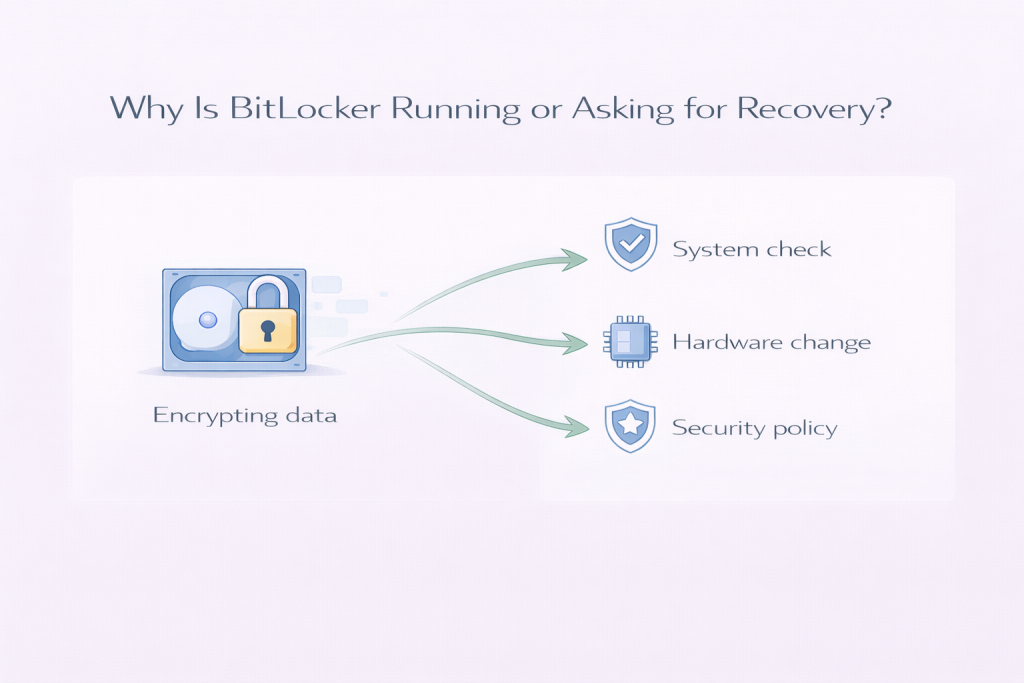
  • How to Find Your BitLocker Recovery Key (and What It Means If It Doesn’t Work)

    When Windows asks for a BitLocker recovery key, it doesn’t explain much. It simply stops and waits. That lack of context is what causes most of the panic.

    In most cases, the key already exists and hasn’t gone anywhere. The real issue is knowing where it was stored and recognising it when you see it.


    What the recovery key actually is

    The BitLocker recovery key is a fixed 48-digit number created when encryption was enabled. It doesn’t change unless BitLocker is turned off and re-enabled.

    Windows isn’t generating a new key. It’s asking for the one that already belongs to that drive.


    Where the key is usually stored

    Microsoft account

    If you signed into Windows with a Microsoft account, the recovery key is often stored there automatically.

    On another device, go to:

    account.microsoft.com/devices/recoverykey

    Sign in with the same account used on the PC.

    You may see several keys. That’s normal. Each encrypted drive gets its own entry.

    This is where most people find it.


    Work or school systems

    If the device was issued or managed by an organisation, the key is usually stored by them. Even if the PC looks personal, this still applies.

    In that case, only IT support can retrieve it.


    Saved copies

    Some users saved the key during setup:

    • to a USB drive
    • to cloud storage
    • as a printed page

    It’s worth checking carefully. People often forget they did this.


    Entering the key correctly

    The recovery screen is strict.

    • Numbers only
    • Dashes are added automatically
    • One wrong digit means rejection

    Typing errors are far more common than genuinely invalid keys.


    If the key doesn’t work

    A rejected key doesn’t automatically mean it’s wrong.

    Common reasons include:

    • using a key for a different drive
    • using an old key after BitLocker was re-enabled
    • simple entry mistakes

    Double-check before assuming anything worse.


    When the key truly can’t be found

    This is the hard boundary.

    If the recovery key was never saved and you can’t access the account it was tied to, the data cannot be recovered. That’s not a Windows limitation — it’s the point of full-disk encryption.

    It’s less common than people fear, but it does happen.


    What not to do

    Don’t:

    • reset the system before checking properly
    • trust “BitLocker bypass” tools
    • reinstall Windows in frustration

    Those actions don’t recover encrypted data.


    Closing thought

    A BitLocker recovery prompt feels final, but most of the time it isn’t. If the key exists, using it correctly resolves the issue. If it doesn’t, encryption is doing exactly what it was designed to do.

  • Why Windows Can Get Stuck in a BitLocker Safe Mode Loop

    Bitlocker loop

    If your PC suddenly keeps booting into Safe Mode, or repeatedly asks for a BitLocker recovery key, it’s understandable to feel worried. It can look like Windows is broken, locked, or stuck in some kind of loop you didn’t cause. Many people fear they’ve lost access to their files or that something serious has gone wrong.

    In most cases, though, this situation is Windows reacting to a change, not failing outright. BitLocker and Safe Mode are both designed to protect your system, and sometimes they interact in ways that feel far more dramatic than they actually are.


    What’s Normal — and What Isn’t

    It’s normal for Windows to ask for a BitLocker recovery key after certain changes. These include system updates, firmware changes, or booting in a way Windows considers unusual. From Windows’ point of view, it’s simply checking that the person starting the PC is authorised.

    It’s also normal for Safe Mode to limit what Windows can load. Safe Mode strips things back to the basics so problems can be isolated. That restricted environment is exactly why BitLocker sometimes reacts.

    What’s not normal is being permanently locked out with no recovery options, or Windows repeatedly rebooting without explanation. Those cases are much rarer than they feel at first, and they’re usually caused by something specific rather than random failure.


    Why This Looks Worse Than It Is

    BitLocker problems tend to happen at the worst possible moment — during startup. When something goes wrong at boot, you don’t get the comfort of a familiar desktop or clear error messages. Instead, you’re faced with a stark screen asking for a long recovery key.

    That lack of context makes the situation feel far more serious. In reality, Windows is often just being cautious. It has noticed that the system isn’t starting in its usual way and is pausing until it’s confident everything is safe.

    Safe Mode adds to that feeling. Because it looks different and behaves differently, it’s easy to assume the system is damaged, even when it isn’t.


    Why System Screens and Messages Can Be Misleading

    Windows doesn’t explain why BitLocker is triggered in plain language. It simply asks for a recovery key. There’s no message saying “this happened because of an update” or “this is temporary”.

    This is similar to how tools like Task Manager can make background activity or CPU usage look alarming during idle time. You see the symptom, but not the reason behind it.

    BitLocker screens are the same. They show the security check, not the chain of events that led to it.


    Common Underlying Causes (In Plain English)

    Most BitLocker Safe Mode loops trace back to one of a few situations:

    Windows updates or restarts
    Large updates sometimes change low-level system components. When Windows restarts afterwards, BitLocker may see that as a meaningful change and ask for confirmation.

    Firmware or BIOS changes
    Even automatic firmware updates can trigger BitLocker. These updates affect how the computer starts, so Windows checks that nothing suspicious has happened.

    TPM and security checks
    BitLocker relies on a small security chip to confirm the system hasn’t been tampered with. If that check doesn’t line up perfectly — even briefly — Windows errs on the side of caution.

    Safe Mode itself
    Safe Mode bypasses many normal startup checks. BitLocker can interpret that as an unexpected boot path and pause until the recovery key is entered.

    Repeated failed startups
    If Windows doesn’t start cleanly a few times, it may change its boot behaviour. That alone can be enough to trigger BitLocker, even though nothing is actually broken.

    None of these mean your files are damaged. They mean Windows is being conservative.


    When It Usually Settles Down on Its Own

    In many cases, once the recovery key is entered and Windows is allowed to start normally, the issue does not return. BitLocker recognises that the system is intact and resumes normal operation.

    If the trigger was an update or one-off change, things often settle after:

    • One or two successful boots
    • Completing background setup tasks
    • Returning to a normal startup instead of Safe Mode

    This can take minutes, or sometimes a day or two if Windows is finishing background activity related to updates.


    When It’s Worth Investigating Further

    It’s reasonable to dig deeper if:

    • The recovery key is requested every single boot
    • You cannot reach normal Windows at all
    • The system re-enters Safe Mode without you asking it to
    • The same screen appears even after successful startups

    These patterns suggest something is repeatedly changing or failing during startup. That doesn’t mean disaster, but it does mean Windows isn’t getting the “all clear” it expects.


    What Not to Do

    This is where many people make things worse, usually out of frustration or panic.

    Don’t disable BitLocker blindly
    Turning off security features without understanding the situation can create new problems, especially if Windows is mid-update.

    Don’t repeatedly force restarts
    Hard power-offs can make Windows think the system is unstable, reinforcing the loop.

    Don’t reset or reinstall immediately
    Data loss often happens because people assume the system is unrecoverable when it isn’t.

    Don’t follow “bypass” advice from random forums
    Anything suggesting you defeat encryption or skip security checks is risky and often outdated.

    In most cases, patience and clarity work better than drastic action.


    A Calm Takeaway

    A BitLocker Safe Mode loop looks intimidating, but it’s usually a sign of Windows protecting itself, not falling apart. The system is pausing because something changed, not because your data is gone.

    If the PC starts normally after a recovery key and stays stable, the safest response is often to let things finish in the background and keep an eye on it. If it doesn’t settle, that’s when a more careful investigation makes sense — not panic.

    Windows can be blunt and unhelpful in how it communicates problems, but most of the time, it’s acting cautiously rather than catastrophically.

  • Is My Hard Drive Failing or Just Busy?

    When a hard drive is constantly active or the PC feels slow, it’s natural to worry about drive failure. Storage issues feel serious, and the fear of data loss makes any unusual behaviour feel urgent.

    In many cases, though, a busy drive is not the same as a failing one.

    What’s Normal vs What Isn’t

    A busy drive is normal if:

    • Activity comes and goes
    • Performance improves over time
    • No unusual noises occur

    It’s more concerning if:

    • Performance degrades rapidly
    • The drive makes persistent clicking or grinding sounds
    • Errors or crashes become frequent

    Busy behaviour is common. Physical failure is less so.

    Why It Often Looks Worse Than It Really Is

    Hard drives are mechanical and slow by modern standards. Background activity during idle periods can easily saturate them, making the system feel strained even when nothing is actually broken.

    This makes routine behaviour feel like a warning sign.

    Why System Metrics Can Be Misleading

    High disk usage doesn’t indicate damage. It only shows that the drive is occupied. A healthy drive can be busy for long periods without failing.

    Metrics alone can’t distinguish between workload and wear.

    Common Underlying Causes

    A drive that seems busy is often dealing with:

    • Background system tasks
    • Security scans
    • Indexing
    • Limited performance due to age
    • Nearly full storage

    None of these necessarily indicate failure.

    When It Usually Settles on Its Own

    If the drive is healthy:

    • Activity reduces once tasks finish
    • Performance returns during idle periods
    • The system stabilises over time

    Improvement is reassuring.

    When It’s Reasonable to Investigate Further

    It’s worth investigating if:

    • Performance declines rapidly
    • Errors appear repeatedly
    • Unusual noises persist

    These can point to genuine hardware problems.

    Common Mistakes That Make Things Worse

    Avoid:

    • Panicking and reinstalling Windows immediately
    • Running repeated aggressive disk tests
    • Ignoring backups altogether

    Overreaction can cause more harm than the original issue.

    Closing Thoughts

    A busy hard drive is far more common than a failing one. If activity settles and performance returns, the drive is usually fine. If warning signs appear, that’s the time to investigate calmly.

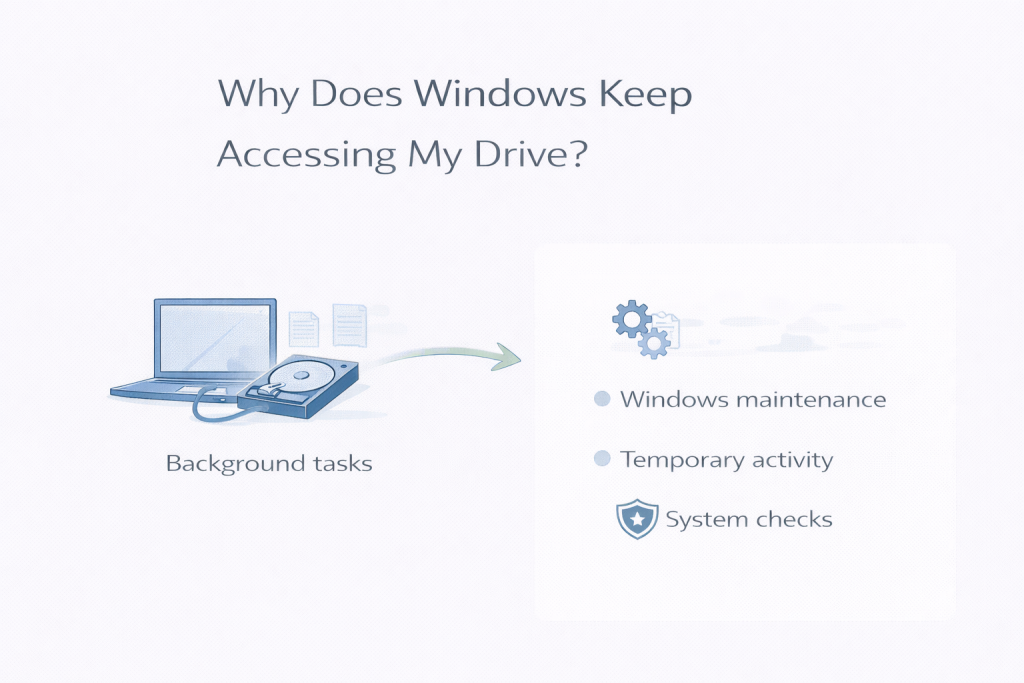
  • Why Does Windows Keep Accessing My Drive?

    Hearing or seeing constant drive access can feel intrusive, especially when you’re not actively using the PC. It’s natural to wonder why Windows keeps reading or writing to the drive without obvious reason.

    In most cases, this behaviour is routine rather than suspicious.

    What’s Normal vs What Isn’t

    It’s normal for Windows to access the drive:

    • During background maintenance
    • After updates
    • When monitoring system health
    • When the system is idle

    It’s less normal if:

    • Access never stops
    • The PC becomes unusable
    • Errors or crashes occur

    Regular access is expected. Constant disruption is not.

    Why It Often Looks Worse Than It Really Is

    Drive access is more noticeable than other background activity. On some systems, you can hear it or see indicator lights, which makes normal maintenance feel excessive.

    Windows schedules much of this work during idle periods to avoid interrupting active use.

    Why System Metrics Can Be Misleading

    Task Manager shows activity, but not purpose. It doesn’t clearly indicate whether Windows is:

    • Scanning
    • Indexing
    • Cleaning up
    • Updating files

    Without that context, the behaviour can feel unexplained.

    Common Underlying Causes

    Windows frequently accesses the drive for:

    • Update preparation
    • File indexing
    • Security monitoring
    • System diagnostics
    • App background tasks

    These are part of keeping the system stable and secure.

    When It Usually Settles on Its Own

    In many cases:

    • Drive access reduces after maintenance completes
    • Activity becomes less noticeable
    • Performance improves during idle periods

    If access gradually decreases, that’s normal.

    When It’s Reasonable to Investigate Further

    Investigate further if:

    • Access is constant for long periods
    • Performance degrades steadily
    • Warnings or errors appear

    These may point to storage or software issues.

    Common Mistakes That Make Things Worse

    Avoid:

    • Blocking Windows background processes
    • Using third-party “monitoring blockers”
    • Disabling update-related services

    These can cause instability or failed updates.

    Closing Thoughts

    Windows accessing the drive regularly is usually part of routine maintenance. If activity settles naturally, it’s a sign the system is working as designed.

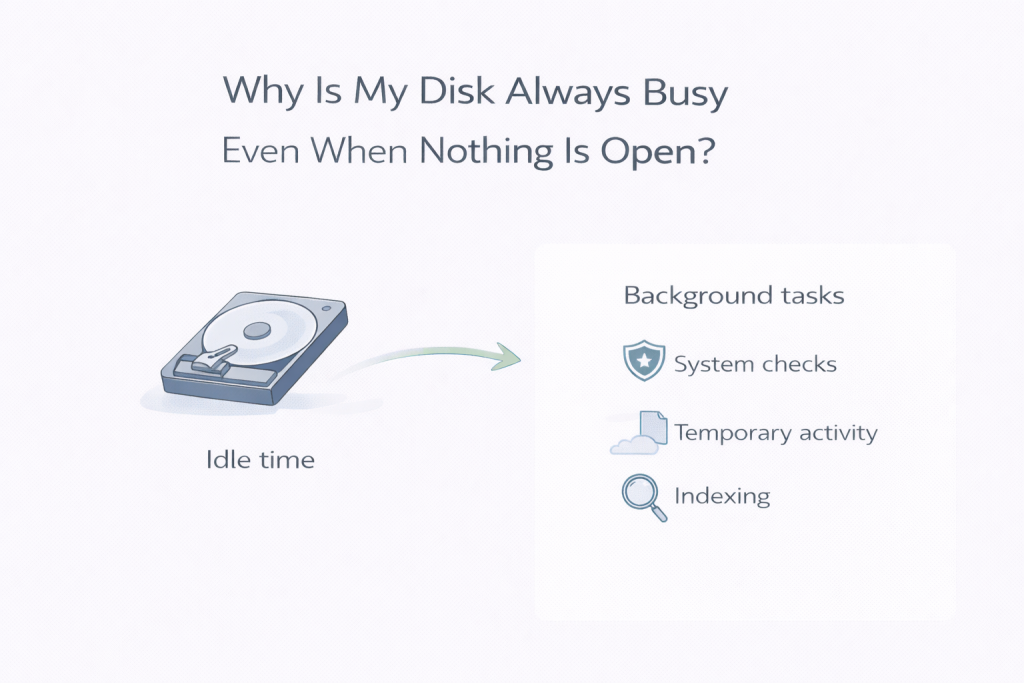
  • Why Is My Disk Always Busy Even When Nothing Is Open?

    It can be unsettling to see constant disk activity when no apps are open and you’re not actively doing anything. The system feels busy for no visible reason, and it’s easy to assume something is wrong or out of control.

    In many cases, this behaviour is normal and tied to how Windows manages background work.

    What’s Normal vs What Isn’t

    It’s normal for a disk to stay active:

    • After startup
    • After updates
    • During background maintenance
    • When the system appears idle

    It’s less normal if:

    • Disk activity never slows down
    • The PC remains sluggish all day
    • Performance steadily worsens

    Occasional background activity is expected. Constant disruption is not.

    Why It Often Looks Worse Than It Really Is

    When nothing is open, expectations are high. Any noise, delay, or blinking disk light feels unnecessary. In reality, Windows uses quiet periods to catch up on tasks it avoids running during active use.

    This makes normal background behaviour feel intrusive.

    Why System Metrics Can Be Misleading

    Disk usage doesn’t show intent. Task Manager can’t easily distinguish between:

    • Heavy transfers
    • Many small background requests
    • Maintenance tasks working through queues

    This makes the disk look constantly “busy” even when it’s making steady progress.

    Common Underlying Causes

    A disk that appears busy at idle is often handling:

    • File indexing
    • Security scanning
    • System cleanup
    • Update-related tasks
    • App background services

    These processes are routine and usually temporary.

    When It Usually Settles on Its Own

    In many cases:

    • Activity reduces once maintenance completes
    • The system becomes responsive again
    • Disk usage drops during idle periods later in the day

    If things quieten down naturally, that’s a reassuring sign.

    When It’s Reasonable to Investigate Further

    It’s worth investigating if:

    • Disk activity never eases
    • Performance remains poor for days
    • Errors or warnings appear

    These may indicate deeper storage issues.

    Common Mistakes That Make Things Worse

    Avoid:

    • Disabling essential background services
    • Installing aggressive “drive management” tools
    • Restarting repeatedly without allowing tasks to finish

    These can interrupt normal system behaviour.

    Closing Thoughts

    A disk that stays busy when nothing is open is often just Windows doing background work. If activity settles over time, the system is usually functioning as intended.

  • Why Is My SSD Slower Than It Should Be?

    SSDs are expected to feel fast, so when performance seems disappointing, it can be confusing and worrying. File operations may feel slower than expected, or the system may hesitate during tasks that should be instant.

    In many cases, SSD slowdowns are situational rather than permanent.

    What’s Normal vs What Isn’t

    It’s normal for SSDs to slow down:

    It’s less normal if:

    • Performance is consistently poor
    • The system feels no faster than with a hard drive
    • Slowdowns worsen rapidly

    Temporary slowdowns are normal. Persistent ones are not.

    Why It Often Looks Worse Than It Really Is

    SSDs manage data internally in complex ways. Background activity, cleanup processes, and write management can temporarily reduce performance, especially during idle maintenance periods.

    This can make a healthy SSD feel sluggish for short periods.

    Why System Metrics Can Be Misleading

    Disk usage percentages don’t reflect SSD performance well. An SSD can show low usage but still be busy with internal operations that affect responsiveness.

    This makes slowdowns feel unexplained.

    Common Underlying Causes

    SSD slowdowns are often caused by:

    • Low free space
    • Background maintenance
    • Firmware behaviour
    • Thermal limits
    • Power management settings

    These are usually normal operating characteristics.

    When It Usually Settles on Its Own

    In many cases:

    • Performance improves once background tasks finish
    • Responsiveness returns during idle periods
    • Short-term slowdowns resolve naturally

    If speed fluctuates rather than declines steadily, that’s reassuring.

    When It’s Reasonable to Investigate Further

    Investigate further if:

    • Performance remains poor for long periods
    • The SSD overheats regularly
    • Errors or warnings appear

    These may indicate configuration or health issues.

    Common Mistakes That Make Things Worse

    Avoid:

    • Filling the SSD completely
    • Running unnecessary disk tools
    • Chasing benchmark numbers obsessively

    These can reduce real-world performance.

    Closing Thoughts

    SSDs don’t always perform at peak speed, especially during background activity. If performance recovers naturally, the drive is usually functioning normally.

  • Why Does My PC Freeze Because of Disk Activity?

    Freezing caused by disk activity can feel sudden and severe. The mouse may stop responding, windows may hang, and the system appears locked — only to recover moments later.

    In many cases, these freezes are caused by temporary disk saturation rather than a system failure.

    What’s Normal vs What Isn’t

    Short freezes can be normal if:

    • They last only a few seconds
    • They happen during startup or maintenance
    • The system recovers fully afterward

    It’s less normal if:

    • Freezes happen frequently
    • The system becomes unusable
    • Recovery takes a long time

    Brief pauses are expected. Repeated lockups are not.

    Why It Often Looks Worse Than It Really Is

    When the disk is fully occupied, the system can’t respond to input until current requests finish. Even short delays feel dramatic because everything appears to stop at once.

    This often happens when background tasks run during idle periods and temporarily take priority.

    Why System Metrics Can Be Misleading

    Task Manager may show disk usage at 100%, but it doesn’t explain why the disk is busy. Small background tasks can queue up and block responsiveness even though no large transfers are happening.

    This makes freezes feel unpredictable and alarming.

    Common Underlying Causes

    Disk-related freezes are often caused by:

    • Security scans accessing many files
    • Indexing activity
    • Update-related file operations
    • Limited disk performance
    • Nearly full drives

    These are common scenarios rather than rare faults.

    When It Usually Settles on Its Own

    In many cases:

    • Freezes stop once background tasks finish
    • Responsiveness returns naturally
    • The system stabilises during idle periods

    If freezing reduces over time, that’s a positive sign.

    When It’s Reasonable to Investigate Further

    You may want to investigate if:

    • Freezes become more frequent
    • The system fails to recover
    • Errors or warnings appear

    These can indicate deeper disk issues.

    Common Mistakes That Make Things Worse

    Avoid:

    • Forcing restarts repeatedly
    • Installing aggressive “disk fix” software
    • Disabling essential background services

    These often increase instability.

    Closing Thoughts

    Disk-related freezes are usually caused by temporary saturation rather than failure. If the system recovers on its own, it’s often best to let background activity finish.

  • Why Is My Hard Drive So Slow?

    A slow hard drive can make an otherwise capable PC feel frustratingly unresponsive. Simple actions like opening files, launching apps, or even clicking menus can feel delayed, which naturally leads people to worry that the drive is failing.

    In many cases, a slow hard drive is behaving as expected for its age and type rather than showing signs of imminent failure.

    What’s Normal vs What Isn’t

    Traditional hard drives are mechanical devices, and they are slower by design than newer storage. It’s normal for them to feel sluggish:

    • When starting the PC
    • When opening large folders
    • When background activity is running

    It’s less normal if:

    • The system becomes unusable for long periods
    • Performance keeps getting worse rapidly
    • You hear persistent clicking or grinding noises

    Gradual slowness is normal. Sudden, severe degradation is not.

    Why It Often Looks Worse Than It Really Is

    Hard drives handle one task at a time. When Windows runs background tasks during idle periods, even modest system activity can completely occupy the drive.

    This makes everything feel slow at once, even though the drive isn’t actually “overworked” in the way a CPU might be.

    Why System Metrics Can Be Misleading

    Disk usage percentages don’t reflect speed well. A hard drive can show 100% usage while only transferring a small amount of data, especially if many small requests are happening at once.

    This makes the drive look overwhelmed when it’s simply responding to its physical limitations.

    Common Underlying Causes

    Slow hard drive performance is often caused by:

    • Background maintenance
    • Security scanning
    • File indexing
    • Fragmented data
    • Limited mechanical speed

    These are normal characteristics rather than faults.

    When It Usually Settles on Its Own

    In many cases:

    • Performance improves once background activity finishes
    • The system becomes responsive again during idle periods
    • Slowness is most noticeable only at certain times

    If responsiveness returns, the drive is likely functioning as expected.

    When It’s Reasonable to Investigate Further

    It’s worth investigating if:

    • Slowness worsens quickly
    • The drive makes unusual noises
    • Errors or warnings appear

    These may indicate physical wear rather than routine behaviour.

    Common Mistakes That Make Things Worse

    Avoid:

    • Installing “drive acceleration” tools
    • Running aggressive disk utilities repeatedly
    • Ignoring very low free space

    These can increase wear or reduce stability.

    Closing Thoughts

    Hard drives are slower by nature, especially during background activity. If performance improves on its own, the drive is usually doing what it can within its limits.